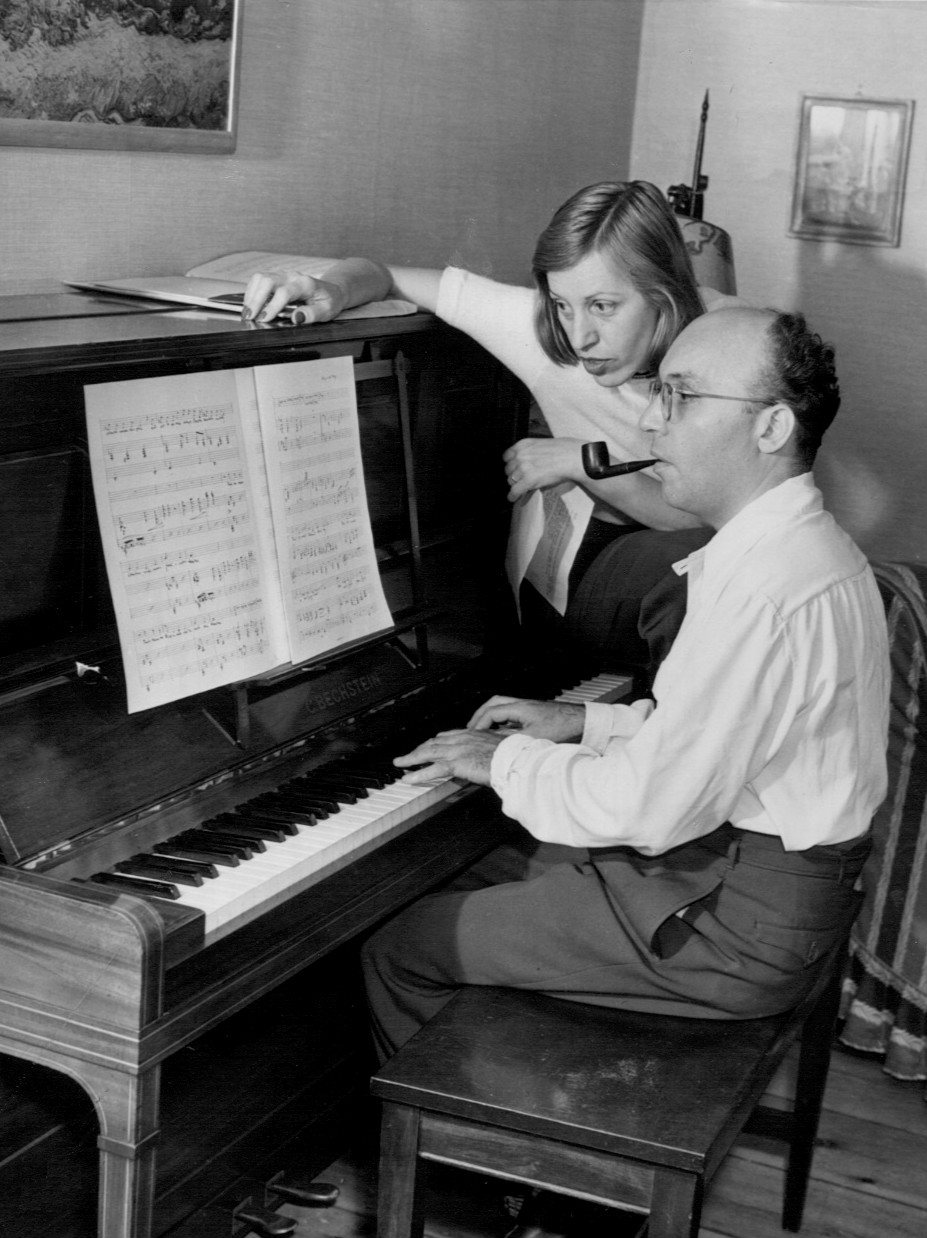
Brook House, the 19th century home in the Rockland County hamlet of New City that once belonged to legendary composer Kurt Weill and singer-actress Lotte Lenya, is on the market for $2,295,000 with Ellis Sotheby’s International Realty.
Built in 1880, Brook House is a five-bedroom, four-bath estate covering more than 4,600 square feet on 5.5 acres at 116 South Mountain Road within the namesake artists community that served as a creative haven for cultural figures who shaped American art, theater, film and music.
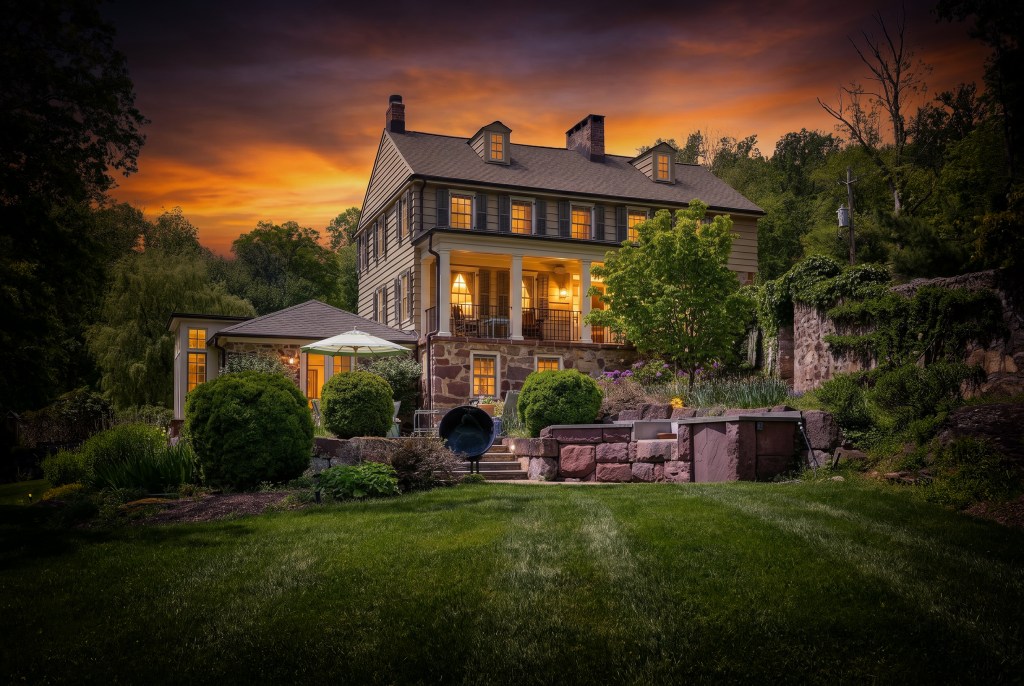
A sunset view of Brook House on South Mountain Road in New City. Photo: Wills Studio
Weill composed the music for “The Threepenny Opera” with playwright Bertolt Brecht, including its famed song, “Mack the Knife,” popularized by Bobby Darin, Frank Sinatra, Louie Armstrong and others. He and also wrote music for a version of “Alabama Song,” popularized years later by The Doors.
German-born Weill’s other stage compostions include “Rise and Fall of the City of Mahogany,” “The Seven Deadly Sins,” “Lady in the Dark,” “One Touch of Venus,” and “Lost in the Stars.”
Lenya starred as ”Pirate Jenny” in “The Threepenny Opera” on stage and screen, and later won a Tony Award for her performance in ”Cabaret” on Broadway and an Oscar for the film ”The Roman Spring of Mrs. Stone.”
The couple moved to South Mountain Road in New City in 1941, according to the Historical Society of Rockland County, and are buried in Mount Repose Cemetery in Haverstraw.
The property also previously belonged to Rollo Peters, co-founder of the Theatre Guild and a major force in American stage production. The estate has had only four owners in the last 110 years.
The current owners acquired the property 33 years ago, restoring the estate’s 19th century architecture while incorporating modern features, according to Ellis Sotheby’s. The restoration was completed in collaboration with New York interior designer Gail Jacobs, known for designing residences for notable musical figures including Leonard Bernstein’s apartment at The Dakota in Manhattan.
Jacobs curated antiques, furnishings and custom lighting to complement Brook House’s artistic legacy including custom-selected Ann-Morris lighting and antique Holophane fixtures.
The estate contains period hand-hewn beams, stone and boulder walls, wide plank pine and white oak flooring, high ceilings, French doors and four fireplaces. Mantels include both a 19th-century carved wood surround and a 19th-century Louis XV-style limestone mantelpiece.
The main residence is composed of seven to eight rooms, including three bedrooms and two baths. A separate legal guest residence — contributing to the property’s zoning as a two-family estate — includes two bedrooms, one-and-a-half baths, a full kitchen, living room with fireplace and a walk-out lower-level den.
The estate includes an oversized workshop garage, brick potting shed, garden shed, chicken coop and artesian well.
Brook House’s landscape comprises mature flowering gardens, stone walls, rolling fields and woodland paths. A rebuilt stone bridge arches over a branch of the Hackensack River, which flows through the estate.
The South Mountain Road enclave is associated with some of the most influential creative figures of the 20th century, including playwright Maxwell Anderson; artist, architect and potter Henry Varnum Poor; sculptor John Mowbray-Clark; painter Arthur B. Davies; actor Burgess Meredith; Paramount Pictures founder Adolph Zukor; filmmaker John Huston; and Mick Jagger, who lived there in the late 1970s.
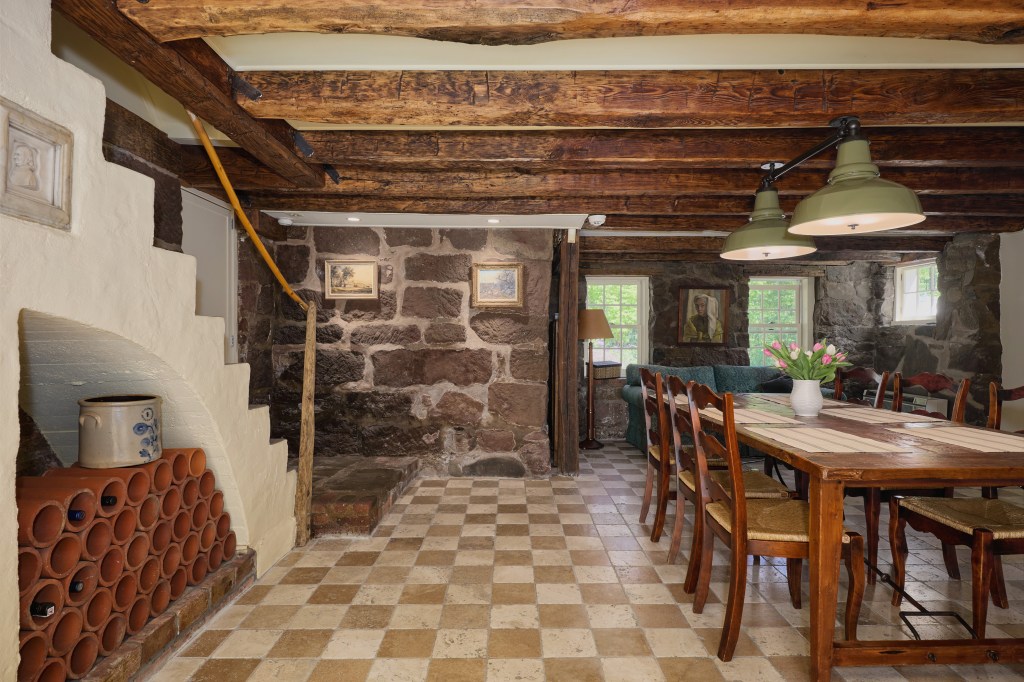
Brook House’s owners have preserved its period hand-hewn beams, stone and boulder walls and wide plank flooring. Photo: Wills Studio
Richard Ellis, listing agent and owner of Ellis Sotheby’s International Realty in Nyack, said the home is a culturally significant part of the artistic history of the region and the broader story of New York’s mid-century art scene. “Brook House offers a once-in-a-generation opportunity to own a residence where architecture, landscape and cultural history converge in one of the Northeast’s most quietly legendary artist communities,” he said. “The result is a rare blend of historic authenticity, wonderful provenance, artistic legacy and refined country design.”
The property borders the 91-acre Davenport Preserve and West Branch Conservation Land Trust.

